
Last updated: August 10, 2026
A planogram sounds like a small thing — a diagram of where products sit on a shelf. In practice, it's one of the highest-leverage documents a retailer produces. Get it wrong and you get uneven facings, empty pegs nobody notices for weeks, and store teams improvising because "the plan doesn't match the fixture." Get it right, consistently, across hundreds of stores, and you can contribute to higher sales per square foot and fewer out-of-stocks.
The market for the best planogram software for retail ranges from lightweight drag-and-drop editors that a single category manager can learn in an afternoon, to enterprise space-planning suites with performance analysis tied into supply chain and demand forecasting. Below are 10 tools that consistently show up in retail and CPG shortlists, based on their public feature sets, documented pricing, and how they're positioned by their own vendors and by independent review platforms like G2 and Capterra.
What Is Planogram Software?
Planogram software is a category management tool that helps retailers and CPG manufacturers plan, visualize, and distribute shelf and fixture layouts. At a basic level, it's a drawing tool: drag products onto a virtual shelf, set facings, export a PDF. More advanced platforms go further — they pull in sales and inventory data to generate layouts automatically, adapt them to individual store formats, push them to store teams for execution, and track whether the shelf actually matches the plan.
The gap between those two ends of the market is significant, and it's the main thing to keep in mind while comparing the tools below.
Why Planogram Software Matters
Picture a category manager responsible for 150 stores. They can build one genuinely good planogram by hand — check the sales data, weigh facings, sketch it out, get it right. What they can't do is repeat that process, store by store, fast enough to keep up with a chain that's constantly changing its assortment. That's the actual bottleneck, and it shows up in a few predictable ways:
- Eye-level shelf space often stays locked to whatever sold well at the last reset, even after sales patterns shift, because nobody has re-run the numbers
- A layout built for the average store gets rolled out everywhere, so a high-footfall urban format and a small-format suburban store end up merchandised identically
- New SKUs or promotions sit unlisted on the shelf for weeks because building a store-specific layout takes longer than the team has
- Nobody finds out a store deviated from the plan until someone happens to walk the aisle — by which point the sales impact has already happened
- Category managers end up spending the bulk of their week redrawing shelves rather than figuring out why certain products underperform
This isn't primarily a training or staffing problem — it's a throughput problem. Planogram software exists to turn shelf planning into a process that can scale across a retail network.
How We Selected These Tools
We reviewed public vendor documentation, demo materials, and user reviews on platforms such as G2, Capterra, and Software Advice. Rather than treating every capability as equally important, the comparison came down to a few practical questions:
- Does the software actually generate layouts, or just format them? A tool that lets someone drag products onto a shelf and export a PDF is doing something fundamentally different from one that reads sales and inventory data and proposes a layout on its own. Both have a place, but they solve different problems.
- Can a planogram flex to an individual store, or is it one template for the whole chain? Store dimensions, local demand, and cluster-level assortment differences are where chain-wide templates tend to fall apart. We checked these capabilities against each platform's stated functionality rather than relying on marketing claims alone.
- What happens after the planogram leaves head office? Whether a layout reaches store staff through a mobile app, gets confirmed with a photo or barcode scan, or is simply emailed as a PDF and left for stores to implement can make a significant difference to the tool's practical value.
- Is there real reporting behind the layout, or just the layout itself? Facing efficiency, sales per meter, ABC analysis, and category turnover help distinguish a category management platform from a drawing tool. We noted the presence and depth of these capabilities for each entry.
- How difficult is it to adopt and scale? This covers both ends of the market: whether smaller teams can start with a free tier or trial without a sales call, and whether enterprise buyers can get a realistic view of implementation timelines and support before signing.
- Does it connect to the systems retailers already run? ERP and POS integration — specifically with common platforms such as SAP and Oracle — determines whether a planogram tool can work with live retail data or requires manual data entry to stay current.
Retail Planogram Software Comparison Table
|
Software |
Best For |
Pricing |
Free tier |
Features |
|
PlanoHero |
Retail chains that want planning, automated layout logic, rollout, execution, and shelf performance analysis in one workflow |
$199/month flat, unlimited users (Lite); Enterprise pricing on request |
Yes (14-day, no card) |
Master Rules, 3D/AR planogram views, planogram distribution, photo-verified execution tracking, and shelf performance analysis (Enterprise) |
|
RELEX Solutions |
Large retailers running thousands of stores |
Custom quote only |
Demo only |
Locally optimized planograms tied into a unified forecasting and replenishment platform |
|
Blue Yonder |
Enterprise retailers with complex supply chains |
Contact for pricing |
Demo only |
Cognitive space-planning tools with real-time HQ–store–supplier collaboration |
|
DotActiv |
Mid-market category management teams |
Free tier (40 SKUs); paid from ~$800/year |
Yes (free tier) |
Category management + planogram automation with published pricing tiers |
|
Quant (Quant Retail) |
Producers, distributors, and category teams needing dedicated space planning |
From ~€1,200/user/year |
Yes |
Space planning, category management, and shelf-label printing in one cloud suite |
|
One Door |
Enterprise retailers whose main gap is store-level execution and compliance, not layout creation |
Contact for pricing |
Demo only |
Cloud-based Merchandising Cloud platform with mobile execution instructions, a Planogram Connector for layouts built elsewhere, and VR store-concept design |
|
GoPlanogram |
Small to mid-size retailers and suppliers on a budget |
From $5,500/year (Standard, 5 users) |
Yes |
Browser-based planograms with 2D, top-down, and real-time 3D views |
|
Scorpion Planogram |
Growing chains that want design plus rule-based automation |
Contact for pricing |
Yes (demo) |
One-click 2D-to-3D rendering with a shopper's-eye walkthrough view |
|
SmartDraw |
Single planograms and buyer presentations |
From ~$7.95–9.95/user/month (varies by source/billing term) |
Yes (online demo) |
Template library plus a browser editor for fast, presentable layouts |
|
ShelfLogic |
Small teams building planograms manually |
License-based |
Yes (free download) |
Dedicated desktop planogram editor with facing-level control and reporting, plus ProView/ProView Plus for cloud-based mobile viewing and field edits |
Pricing note: Prices are based on publicly available vendor information and third-party listings checked in 2026. Enterprise pricing may vary by store count, users, modules, and implementation scope. Always confirm current pricing with the vendor.
10 Best Planogram Software
The tools below are presented as a list, not a ranking — there's no single "best" platform, only the best fit for a given store count, budget, and workflow. Order does not imply preference. The comparison is intentionally broad: some tools are full retail planning platforms, while others focus primarily on planogram creation.
PlanoHero
PlanoHero is a cloud-based planogram platform that covers the full merchandising cycle in one system: store and fixture setup, planogram creation, distribution to stores, and execution tracking, used by chains roughly in the 50-to-500-plus-store range. Beyond layout design, it extends into inventory-adjacent functions — helping teams manage replenishment timing, product rotation, and out-of-stock detection alongside the shelf layout itself.
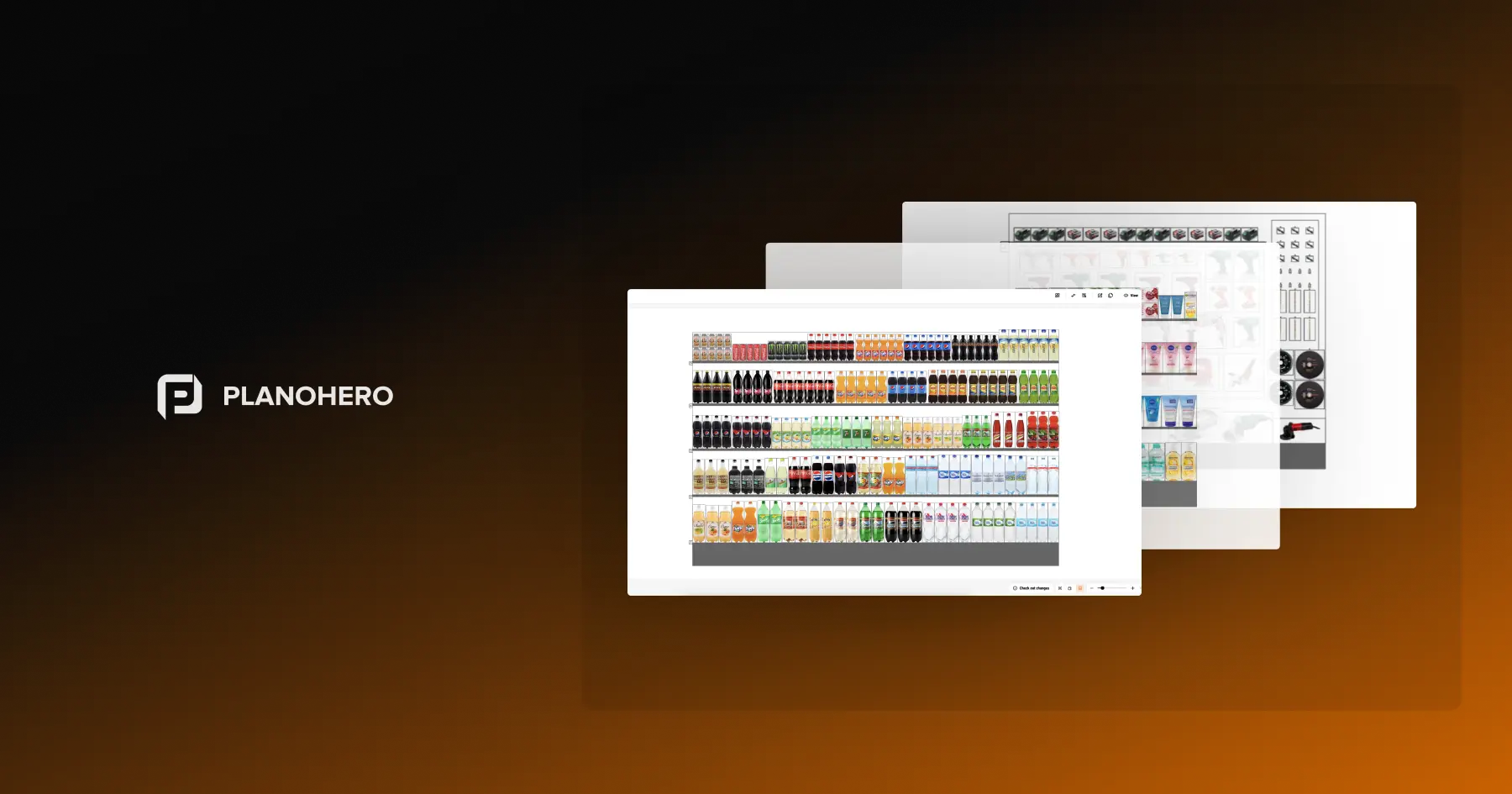
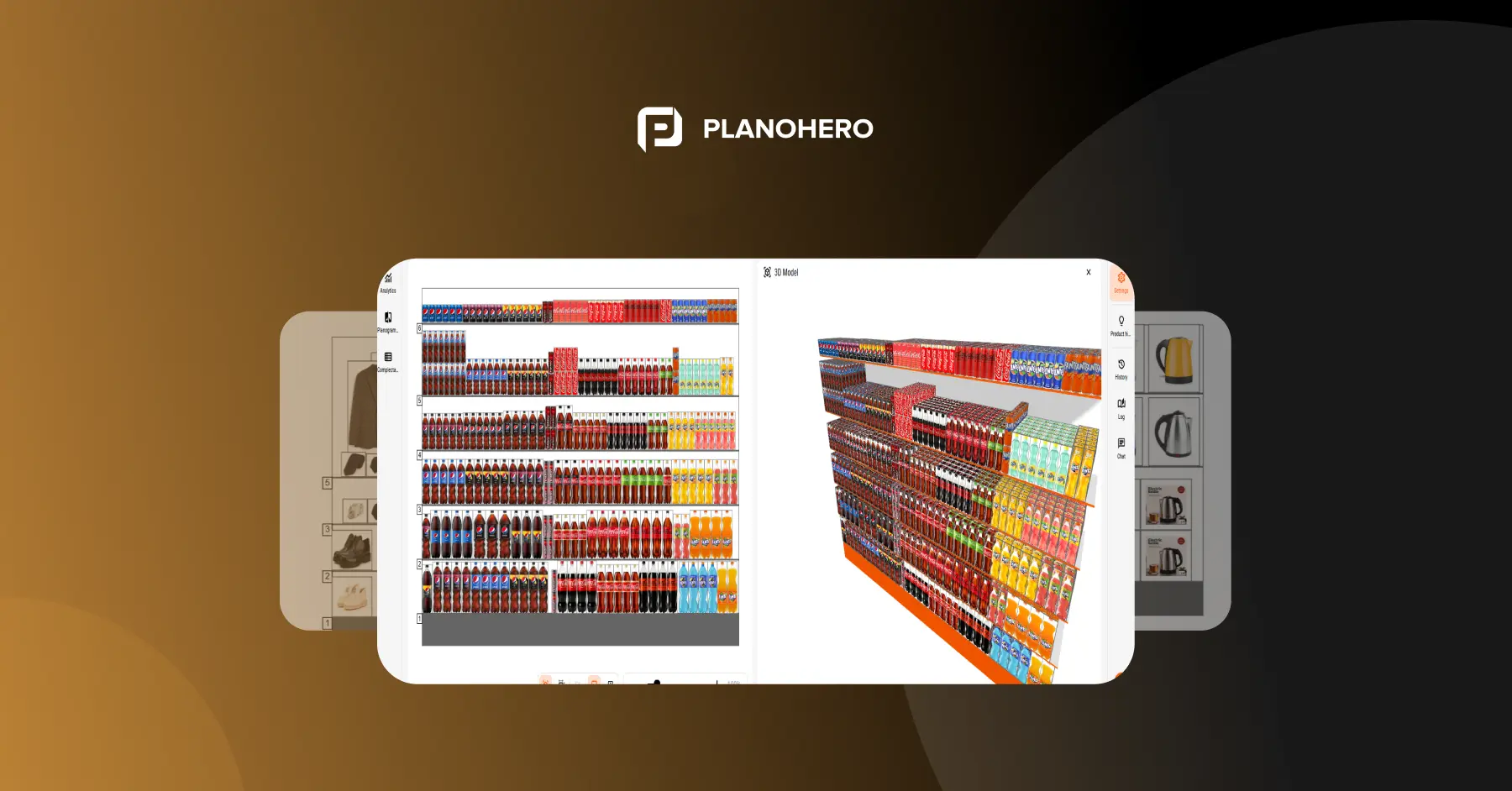
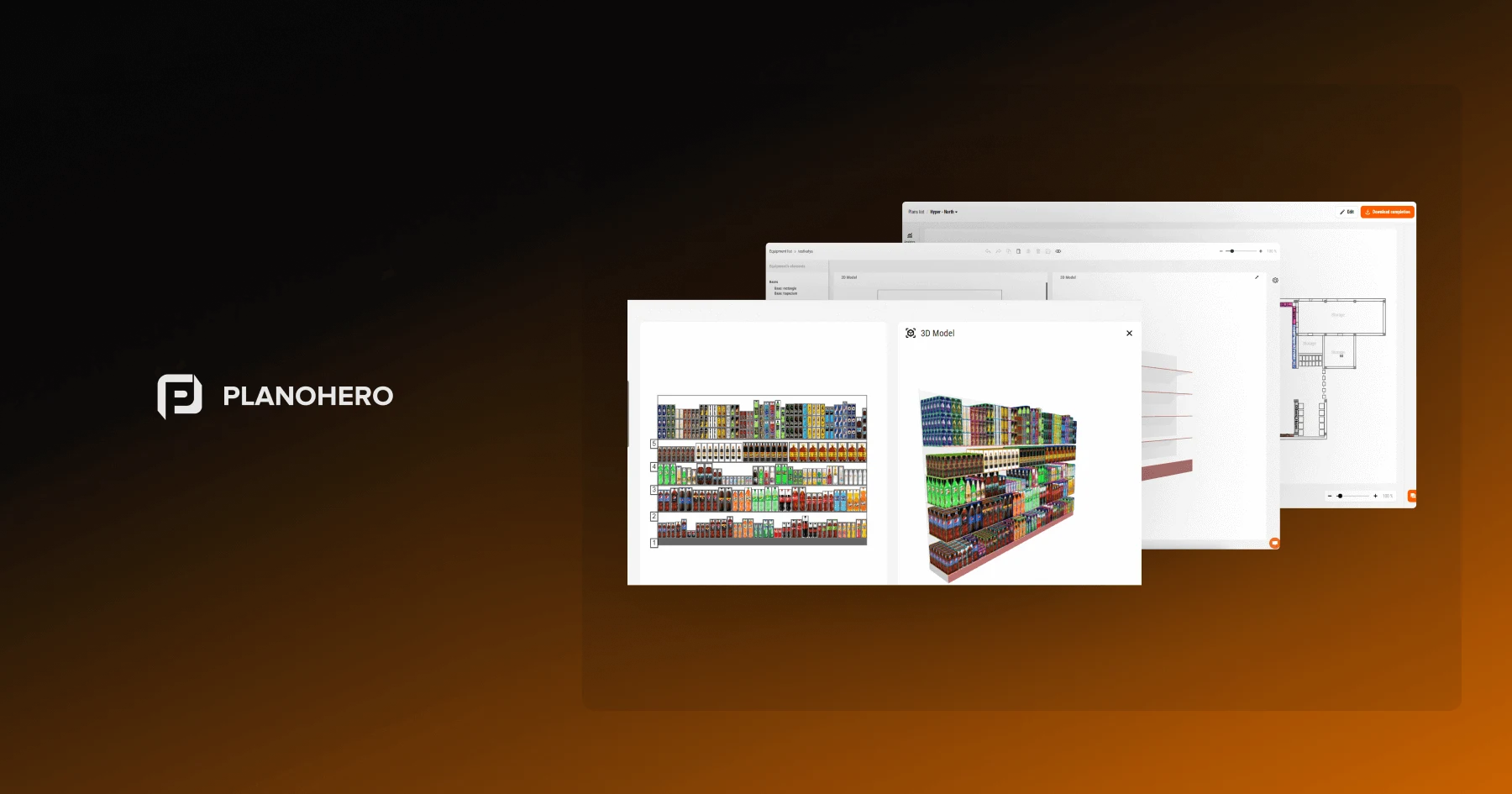
Layout creation starts with importing or building a store floor plan (including from AutoCAD files) and fixture library, then placing products manually or letting the system auto-fill based on sales data. Planograms can be rendered as a 3D model, and the platform also includes an AR (augmented reality) view for reviewing a layout against the physical fixture. A Master Rules feature lets a category manager define grouping, sorting, and placement logic once and apply it across multiple planograms in a single action. This differs from tools where each layout is maintained independently. A separate module flags assortment issues — such as items missing from a planogram or discontinued SKUs still assigned to shelf space — and a heat map overlays store visit and customer behavior data on top of the floor plan, not just sales performance.
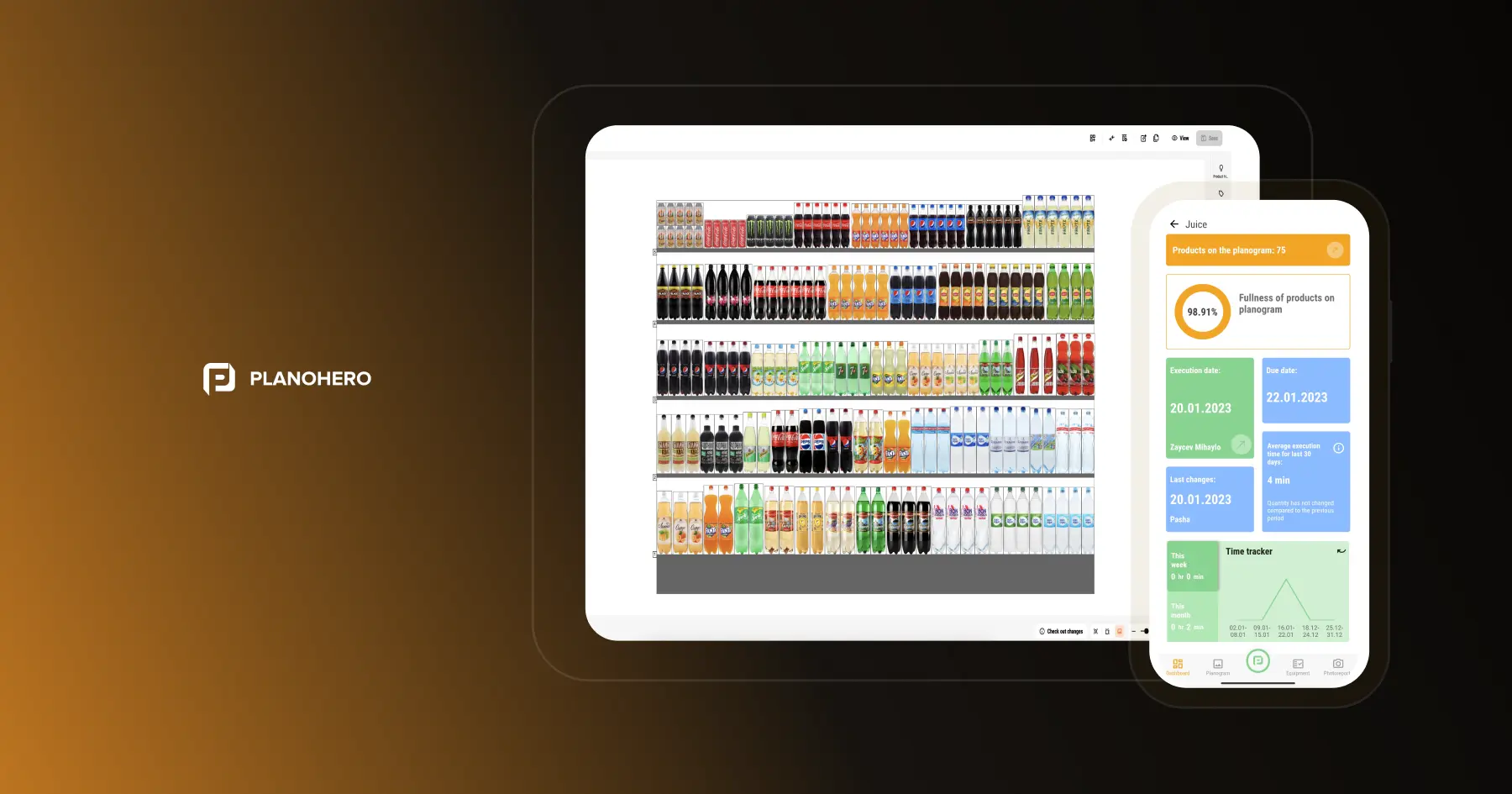
On the execution side, tasks for implementing a planogram can be created and sent directly to store managers, who confirm completion through the mobile app with photo reports; a time tracker records how long each store takes to complete a reset. Analytics cover chain-wide sales and layout performance by store, category, and product, and an AI assistant (Wizora) can be queried directly about execution status or underperforming SKUs instead of requiring a manual report pull.
Best retail size: Growing chains, roughly 50 to 500-plus stores, managing planograms alongside store-level execution and inventory coordination.
Who should choose this software? Retailers that want planogram creation, distribution, and execution verification handled in one platform rather than across separate planning and compliance tools.
Key features:
- Master Rules for applying grouping, sorting, and placement logic across multiple planograms in one action
- 3D and AR (augmented reality) planogram views, alongside AutoCAD floor plan import
- Assortment issue tracking module, flagging gaps or discontinued items on active planograms
- Planogram execution, with mobile photo-report confirmation
- Heat map covering both store visit patterns and customer behavior, in addition to sales-based zone analysis
- Integration with existing ERP, POS, or accounting systems via API, FTP, or an intermediate database, regardless of which system is in place
Pros: Planning, distribution, and execution tracking sit in one system rather than across separate tools; the Lite plan includes unlimited users at a flat monthly rate rather than per-seat pricing; a 14-day free trial lets teams test the platform against their own SKU data before committing.
Cons: Category-level forecasting and assortment analytics are narrower than in enterprise suites like RELEX or Blue Yonder.
Pricing: The Lite plan is a flat $199/month with unlimited users, covering up to 5,000 SKUs and 100 planograms. Enterprise plans are custom-quoted and add the mobile Layout App, Wizora, floor planning, AI layout rules, and deeper data integration. A 14-day free trial is available, testable with up to 1,800 sample SKUs or up to 1,500 of the retailer's own SKUs.
RELEX Solutions
RELEX built its reputation in demand forecasting and replenishment, and its space-planning module is part of a broader Unified Merchandising platform rather than a standalone tool. That matters in practice: planograms are generated using the same demand data that drives inventory and pricing decisions, so a layout change and a replenishment plan don't drift apart.
The system is built to generate locally optimized planograms across large store networks without manual rework for every location, and RELEX Planogram Delivery gives store associates mobile access to layout changes with a direct line back to central teams. For chains with thousands of locations and genuinely diverse store formats, this kind of automation is often closer to a requirement than a nice-to-have.
Best retail size: Large chains with hundreds to thousands of stores across multiple formats.
Who should choose this software? Retailers that already run (or plan to run) forecasting, replenishment, and pricing on a unified platform, and want space planning to pull from the same live demand data instead of a separate system.
Key features:
- Automated, store-specific planogram generation driven by demand forecasting
- Mobile planogram and floor-plan delivery to store teams
- Unified data model connecting space, assortment, pricing, and replenishment
- Cloud-native deployment with regular feature releases
Pros: Deep integration across the retail planning stack; strong track record in grocery and specialty retail at scale.
Cons: Space planning isn't sold as a lightweight standalone product; implementation is a multi-month project that assumes reasonably mature underlying data.
Pricing: RELEX does not publish pricing publicly. Demo available on request.
Blue Yonder
Blue Yonder (formerly JDA Software) is one of the longest-established names in space planning, and its Space Management module remains a common choice among large, multi-format retail chains. In 2026, the company introduced new Cognitive Solutions for Space Planning and Category Management, which let suppliers, store teams, and category managers co-create planograms in real time instead of trading versions by email, with store associates getting a mobile view of live planograms and flagged compliance issues.
Best retail size: Large, multi-format enterprise retailers, typically hundreds of stores and up.
Who should choose this software? Retailers already invested in the Blue Yonder supply chain and demand planning ecosystem who want space planning to plug directly into that existing stack rather than adding a disconnected tool.
Key features:
- Real-time, collaborative planogram creation across HQ, stores, and suppliers
- Store clustering for chain-wide layout differentiation
- Mobile execution guidance with compliance flags on the store floor
- Native integration with Blue Yonder's demand and supply chain planning suite
Pros: Industry-standard tool that most enterprise category teams have already worked with in some form; deep integration for existing Blue Yonder customers.
Cons: Pricing isn't public; the platform is really only a practical choice if you're committed to (or already inside) the Blue Yonder ecosystem, and training investment is non-trivial.
Pricing: Contact Blue Yonder directly; no published tiers.
DotActiv
DotActiv is one of the few platforms on this list with genuinely public pricing, starting with a free tier limited to 40 SKUs and scaling through Lite, Professional, and Enterprise tiers. It bundles planogram automation, store cluster management, retail analytics, and — more recently — AI-assisted placement suggestions (through integrations with tools like Gemini and OpenAI) into one system.
The Auto Planogram Refresh feature updates layouts automatically when underlying sales or assortment data changes, and an approval workflow keeps category sign-off inside the platform rather than in email threads.
Best retail size: Small to mid-market chains, roughly 10 to a few hundred stores, plus individual category management teams.
Who should choose this software? Teams that want to evaluate a real planogram platform on a free tier before spending anything, and mid-sized retailers who want planogramming and category analytics under one roof without an enterprise contract.
Key features:
- Free and Lite tiers with published pricing, useful for evaluation before committing budget
- Auto Planogram Refresh for automatic layout updates
- Store cluster management for localized layouts
- Photorealistic 3D shelf visualization
Pros: The most transparent pricing on this list; a free tier that supports real evaluation before committing budget; strong fit for teams that want planogramming and category analytics in one place.
Cons: Mobile execution and in-store compliance tools are less developed than platforms built execution-first; less suited to very large, structurally complex chains.
Pricing: Free tier for up to 40 SKUs; Lite from roughly; Enterprise pricing on request.
Quant (Quant Retail)
Quant is a specialist in the space it plays in: a cloud-based platform for space planning, category management, planograms, and — somewhat unusually for this category — shelf-label and POS printing in one workflow. It carries one of the stronger independent review scores among dedicated planogram tools, with a 4.8-out-of-5 rating on G2 based on over 50 reviews, skewed toward enterprise users.
It's positioned less as an all-in-one retail suite and more as a focused tool for producers, distributors, and agencies that need to build and maintain accurate standalone planograms without adopting a full merchandising platform.
Best retail size: Mid-size to enterprise producers, distributors, and agencies; also used by larger retail chains as a dedicated space-planning layer.
Who should choose this software? Teams whose main pain point is space and category management specifically, and who don't want (or need) the forecasting, pricing, and replenishment modules bundled into broader platforms.
Key features:
- Cloud-based space planning and category management
- Automatic planogram generation based on sales data and templates
- Shelf-label and point-of-sale material printing built into the workflow
- Product and equipment library for fast planogram assembly
Pros: Strong independent review ratings; clear focus rather than a bloated feature set; reasonable to implement (vendor cites go-live in under 12 weeks).
Cons: Less known outside Europe; not built as an end-to-end merchandising platform with mobile execution tracking.
Pricing: Basic tier reported from around €1,200/user/year; free trial available.
One Door
One Door (also written as OneDoor) is a cloud-based visual merchandising platform founded in 2000 and based in Boston, Massachusetts. Rather than being primarily a layout-drawing tool, it's built as a merchandising execution platform: space planners, visual merchandisers, and store operations teams work from a shared cloud plan — called Merchandising Cloud — to create, roll out, and analyze the physical store experience. A Planogram Connector lets the platform pull in layouts built elsewhere, including from Blue Yonder's planogramming tools, and convert them into mobile-optimized, interactive, step-by-step instructions for store associates, rather than the static PDFs many stores still work from. In 2025, One Door acquired ReadySet VR, adding virtual-reality tools for designing and testing store concepts before they're built out in the field. On G2, the product carries a 4.4-out-of-5 rating from a relatively small review base, with reviewers skewing toward small-business users even though the company's own positioning targets larger retail brands.
Best retail size: Positioned for large, multi-store retail brands, though independent review data currently shows a meaningful share of small-business users as well.
Who should choose this software? Retailers whose main bottleneck is getting an existing planogram followed correctly in-store — mobile-first execution instructions, photo/compliance tracking, and turning plans built in other systems into something a store associate can act on — rather than teams whose primary need is planogram design and layout automation from scratch.
Key features:
- Cloud-based Merchandising Cloud platform connecting planning, in-store execution, and analytics
- Planogram Connector for importing layouts built in other planogramming tools into mobile, interactive plans
- Mobile-first, step-by-step execution instructions for store teams
- VR-based store concept design and testing, added via the 2025 ReadySet VR acquisition
- Image IQ, a patented computer-vision compliance feature that scans display photos to flag missing or misplaced products and signage against each store's specific plan
Pros: Strong execution and compliance layer aimed at getting plans followed in-store; can sit on top of planograms built in another system rather than requiring a full switch; VR concept-testing tools go further than most other entries on this list.
Cons: Pricing isn't published anywhere and isn't listed even on third-party comparison sites; positioned more around execution and compliance than ground-up planogram creation, so teams needing heavy layout automation may still need a dedicated design tool alongside it.
Pricing: Not publicly disclosed. Contact One Door directly for a quote.
GoPlanogram
GoPlanogram is a fully cloud-based planogram builder aimed at retailers and suppliers who want professional output without an enterprise supply-chain platform attached. There's nothing to install: planograms are created, viewed, and shared from a browser, on desktop, tablet, or mobile, and the platform supports importing files in formats like Blue Yonder/JDA PSA.
Its standout feature is view flexibility — 2D, top-down, and real-time 3D — plus built-in heatmaps and comparison reports that give some analytical depth without the complexity of a full category management suite. Pricing is tiered: Standard: from $5,500/year for 5 users, plus $1,100/year for each additional user. Professional: from $9,000/year for 5 users, plus $1,000/year for each additional user. And adds API access, single sign-on, multiple catalogs, and priority support, and an Enterprise tier is custom-quoted for larger teams that need custom integrations or on-prem deployment.
Best retail size: Small to mid-size retailers and CPG suppliers, typically single-digit to low-hundreds of stores.
Who should choose this software? Teams that want professional-quality planograms and multiple view modes fast, without paying for the forecasting and replenishment modules bundled into enterprise suites.
Key features:
- Unlimited planograms and products, plus rule-based planogram generation on every tier
- 2D, top-down, and real-time 3D planogram views
- API access, SSO, and multiple catalogs on the Professional tier
- Custom ERP, PIM, and DAM integrations available on Enterprise
Pros: Transparent, published pricing by tier; no IT overhead to get started; solid visual output for buyer presentations and store execution.
Cons: Per-user pricing on top of the base plan can add up for larger teams; formal compliance and execution-tracking workflows are lighter than in execution-first platforms.
Pricing: Standard from 5,500/year(5 users included,+1,100/additional user/year); Professional from 9,000/year(5 users included,+1,000/additional user/year); Enterprise is custom-quoted with dedicated support and bespoke integrations.
Scorpion Planogram
Scorpion (marketed as Scorpion One) sits between manual drawing tools and full automation platforms. Its signature feature is one-click rendering of a 2D planogram into a walkable 3D environment, letting category managers and merchandisers review a shelf from a shopper's-eye view before anything is built in-store. Beyond visualization, it includes a planogram automation module for rule-based layout generation, plus floor planning and store layout tools.
Best retail size: Growing mid-market chains, typically tens to a few hundred stores, plus manufacturers presenting layouts to retail buyers.
Who should choose this software? Teams that need to present a layout internally or to a buyer before it goes on a shelf, combined with basic rule-based automation for day-to-day planogram building.
Key features:
- One-click 2D-to-3D rendering with a first-person "walk the aisle" view
- Rule-based planogram automation module
- Floor planning alongside shelf-level design
- Cloud-based with team collaboration features
Pros: 3D tooling suited to internal buy-in and supplier presentations; covers both manual design and automation in one product; modular pricing lets smaller teams start without the full suite.
Cons: Automation is rule-based rather than forecast-driven, so it won't adapt to demand shifts the way AI-native platforms do; no built-in photo-based compliance verification.
Pricing: Contact for pricing; demo available.
SmartDraw
SmartDraw isn't a retail platform — it's a general diagramming tool with a well-built planogram module, template gallery, and a browser editor you can try without installing anything. For a single, clean, presentable planogram, it's one of the fastest options in this category to produce output with. What it doesn't do is anything retail-specific: no sales data, no facing logic tied to velocity, no compliance tracking.
Best retail size: Any size, but really built for single planograms rather than multi-store management — independent retailers, CPG reps, or anyone drafting a one-off layout.
Who should choose this software? Teams that need a clean, presentable planogram fast for a buyer meeting or internal deck, and don't need sales data, automation, or multi-store rollout.
Key features:
- Retail fixture and product shape libraries
- Large template gallery for common store and category layouts
- Browser-based editor with a live demo
- Export to PowerPoint, PDF, and image formats
Pros: Fast, cheap, and requires no onboarding; good output quality for presentations.
Cons: Every placement is manual; no data integration or multi-store management — this is a drawing tool, not a category management system.
Pricing: Subscription figures vary by source, from roughly $7.95 to $9.95/user/month depending on billing term.
ShelfLogic
ShelfLogic is one of the older dedicated planogram applications still on the market, and it's stayed relevant by staying narrow: it's a desktop editor built specifically around retail concepts — facings, shelf dimensions, product and fixture databases — rather than a general drawing tool repurposed for retail. Downloadable free trial versions have kept it a common choice for small merchandising teams that don't need (or can't justify) a cloud platform. It's not purely desktop-bound, though: the ProView add-on lets any browser or mobile device view planograms built in the Enterprise Edition, and ProView Plus goes further, letting field staff edit the plan directly from a phone or tablet at the shelf.
Best retail size: Independent retailers and small chains, typically fewer than 20-30 stores, plus small supplier teams.
Who should choose this software? Teams comfortable with a manual, desktop-based workflow who want more retail-specific logic (facings, fixture dimensions) than a generic diagramming tool offers, without a cloud subscription.
Key features:
- Dedicated planogram editor with product and fixture databases
- Facing-level control with automatic space calculations
- Space allocation and product placement reporting
- Downloadable free trial
Pros: More retail logic than generic diagramming software, at a lower cost and lower complexity than enterprise platforms.
Cons: Manual workflow with no AI or automated generation; dated, desktop-centric interface; no mobile execution or compliance tracking.
Pricing: License-based; editions and pricing vary by vendor listing.
How to Choose the Right Planogram Software
Every vendor's feature list looks impressive in isolation. The real test is whether those features solve the specific problem your team has — and that comes down to a handful of practical questions, not a checklist comparison.
1. Match the tool to your actual scale
A single-location retailer and a 500-store grocery chain aren't shopping for the same tool, even if both call it "planogram software." Below a few dozen stores, a manual or lightly automated tool usually keeps up fine. Cross that threshold, and the manual process itself becomes the bottleneck — which is where platforms like RELEX or Blue Yonder start to earn their complexity. DotActiv and Quant sit comfortably in the middle, handling meaningful scale without the enterprise overhead.
2. Know whether you're missing the plan or the proof
This is the split that trips up a lot of buyers. Some teams already have planograms — what they're missing is proof that stores actually followed them. That's a compliance problem, and it's where a platform like One Door fits: it layers execution tracking on top of plans built elsewhere rather than replacing the design tool. Other teams — especially chains opening new locations fast — need the whole chain in one place: build the layout, push it to stores, and confirm with a photo that it actually happened. That's closer to what PlanoHero is built for.
3. Check what your data stack can actually feed it
A planogram tool is only as good as what feeds it. If sales and inventory data lives in SAP or Oracle, most enterprise platforms will connect directly. If it doesn't, smaller tools that rely on flat-file imports may be a more realistic starting point than forcing a heavyweight integration that never quite gets finished.
4. Be honest about how different your stores really are
If every location shares the same footprint, fixtures, and assortment, one chain-wide planogram is genuinely enough — don't pay for localization you won't use. But if formats, store sizes, or local demand vary in any meaningful way, a single template will quietly under-serve half your network. That's the case for a tool built to generate or adapt layouts per store or per cluster.
5. Size the rollout to what your team can absorb
Enterprise platforms are powerful, but "powerful" often means a multi-month rollout before the first planogram ships. Be honest about what your team can realistically manage right now — a mid-market tool that gets adopted and used consistently will usually outperform an enterprise system still being configured a year later.
6. Look past the license fee to the full cost
The sticker price rarely tells the whole story. Per-user fees, paid add-on modules (mobile execution, AI layout generation, extra store clusters), onboarding and training costs, and data-migration work can add up fast — sometimes significantly increasing the effective cost of a "budget" tool. Before signing, ask vendors directly what's included versus billed separately, and get a realistic estimate of what year one will cost once implementation and training are factored in.
Frequently Asked Questions
What is the top planogram software for retail chains?
There is no single best planogram software for every retailer. RELEX and Blue Yonder are better suited to large enterprise environments, while DotActiv, Quant, and PlanoHero can be a better fit for mid-market retailers depending on whether the priority is category management, space planning, or execution.
What is planogram software used for?
It's used to design, generate, and distribute shelf and fixture layouts, and — in more advanced platforms — to verify that stores are actually executing those layouts correctly. It replaces manually drawn shelf diagrams with a system that can pull in sales data, apply facing rules, and update automatically as assortments change.
What is the difference between planogram software and merchandising software?
Planogram software focuses specifically on shelf and fixture layout — where products go, how many facings each gets, and how that layout is documented and distributed. Merchandising software is broader: it typically covers planogram creation as one component alongside assortment planning, replenishment, pricing, promotions, and in some cases store operations. In practice, the line has blurred — several platforms in this list, including RELEX, Blue Yonder, PlanoHero, and One Door, package planogramming or planogram execution inside a wider merchandising workflow rather than selling it as a standalone tool.
How much does planogram software cost?
It varies widely. Lightweight drawing tools like SmartDraw start around $8–10/user/month. Mid-market platforms with published pricing, like DotActiv, start free and scale to $800–7,500/year depending on tier. PlanoHero's entry-level Lite plan is a flat $199/month with unlimited users. Enterprise suites like RELEX, Blue Yonder, and One Door generally don't publish pricing at all. Expect a sales conversation rather than a self-serve checkout for anything at that tier.
Is there free planogram software?
DotActiv offers a genuinely usable free tier limited to 40 SKUs on a single-drop planogram. Several other tools, including ShelfLogic and GoPlanogram, offer free trials rather than an ongoing free tier. Free options are fine for testing a workflow, but most retail chains outgrow them once they need automation, multi-store customization, or ERP integration.
What's the difference between a "planogram tool" and a "space planning platform"?
A planogram tool typically focuses on building and exporting individual shelf layouts. A space planning platform (RELEX, Blue Yonder, DotActiv, Quant) usually adds category-level analytics, store clustering, and often ties into broader assortment or supply chain planning. The line between the two has blurred as more vendors add automation and analytics to what used to be pure drawing tools.
Can planogram software integrate with my POS or ERP system?
Most established platforms support integration with common ERP systems (SAP, Oracle) and POS data feeds, though the depth varies significantly. Enterprise platforms typically offer native connectors; smaller or design-focused tools may rely on CSV/flat-file imports. Always confirm integration specifics with a vendor directly rather than assuming from a feature list — this is one of the areas where marketing language and actual capability diverge most.
How long does implementation typically take?
Browser-based tools like GoPlanogram or SmartDraw can be operational within days. Mid-market platforms like DotActiv or PlanoHero typically take a few weeks to configure product and fixture data properly. Enterprise deployments — RELEX, Blue Yonder — are usually multi-month projects, particularly when they involve connecting live ERP and POS data feeds across a large store network.
Do I need AI-powered planogram generation?
Not necessarily. If your assortment is stable and your store formats are consistent, rule-based or manual tools may be entirely sufficient. AI-assisted generation earns its cost when you're managing frequent assortment changes, many store formats, or a large enough network that manual rebuilds have become a genuine bottleneck for your category team.
Looking for a service to create planograms?
Try a free demo version of PlanoHero