

Last updated: September 1, 2026
A planogram defines the exact location of every product on the shelf — which is what decides whether a customer notices it at all.
Creating a planogram is a strategic process. The result gets evaluated by how effectively the product actually sells, which is why the layout on the shelf has to match the plan exactly. Getting there takes more than just drawing a diagram — it takes a process for creating, distributing, executing, and monitoring planograms with the right tools.
What Should You Look for in a Planogram Maker?
Not every tool called a "planogram maker" or "planogram generator" is built for the same job. It helps to know which category you actually need before comparing options:
- General-purpose diagram tools (drag-and-drop diagram makers built for many use cases, not just retail) are fine for sketching a single planogram occasionally — a one-off layout for one store, with no ongoing tracking.
- Free or entry-level planogram creators typically cap how much you can build (a limited product count, a single store, desktop-only) and work well for learning the basics or a very small operation.
- Retail-grade planogram creation software is built for managing planograms across many stores at once — with product libraries, layout rules, distribution to store teams, and compliance tracking built in, not bolted on.
If you're building one planogram for one store, a simple planogram creator will do the job. If you're managing layouts across a chain and need them to actually match what's on the shelf, that's a different category of tool — which is what the rest of this page covers.
Excel or Dedicated Software: Which Do You Actually Need?
Planograms are often still built in Excel, as ordinary tables with product names. It's familiar, and for a single small layout, it can work. But it breaks down quickly at any real scale:
- Products get confused. Similar SKU names are easy to mix up in a spreadsheet, and Excel isn't built for adding product images inline — so mismatches slip through.
- There's no way to check the shelf against the plan. A merchandiser checking a store against an Excel planogram is comparing a photo to a table by eye, which makes it easy to miss a mismatch.
- It doesn't scale. Once you're managing more than a handful of planograms, keeping every version updated by hand across stores becomes its own full-time problem.
This is where dedicated planogram design software earns its place: it's built specifically to keep the visual layout, the underlying product data, and the store-by-store rollout in sync — something a spreadsheet was never designed to do.
To make this easier, PlanoHero has been built as a dedicated planogram builder: a tool for automating the planogramming process — creating planograms, editing them, sending them to stores, tracking correct placement on the shelves, and getting detailed analytics, all from one shelf planning software platform.
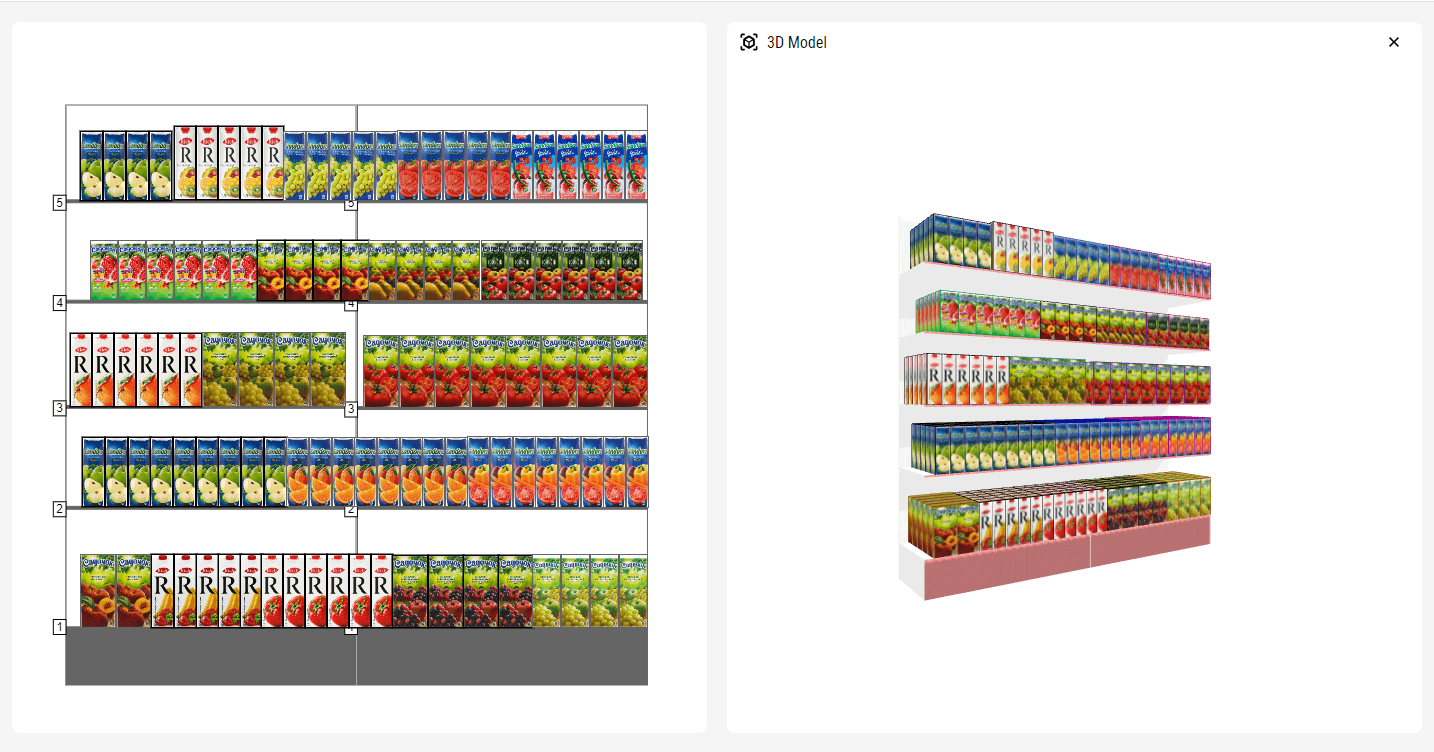
Planogram in the PlanoHero service
Benefits of PlanoHero
- Planograms are created faster than in Excel.
- The service covers the entire process of planogramming: creating planograms, setting up the layout, distributing and executing them in stores, and analyzing effectiveness.
- User-friendly interface with the ability to work with planograms across the entire chain.
- Quickly update products from the image library in the service: built-in search for images and product sizes.
- Ready-made planogram templates and layout rules that carry over to future planograms.
- Access to planograms both from the desktop version and from the PlanoHero mobile app.
- Generating layouts using artificial intelligence (AI).
That automation extends to how the layout itself gets built — including AI-generated placement rules.
How Does AI-Powered Planogram Generation Work?
PlanoHero specialists have implemented artificial intelligence into the service's Layout Rules functionality. Users of the service can now quickly create layouts on the planogram with the help of AI. The "AI Layout Rules" module instantly generates rules for the placement of goods on the shelves and applies them across any store in the chain.
To create your own layout with artificial intelligence, you describe your requirements for a layout rule in a text field — how the products should be laid out on the planogram — and the AI turns that description into a layout rule, automatically setting the appropriate parameters on the planogram.
You can also start from a ready-made prompt. For example, you can create a vertical layout by brand that takes sales indicators into account.
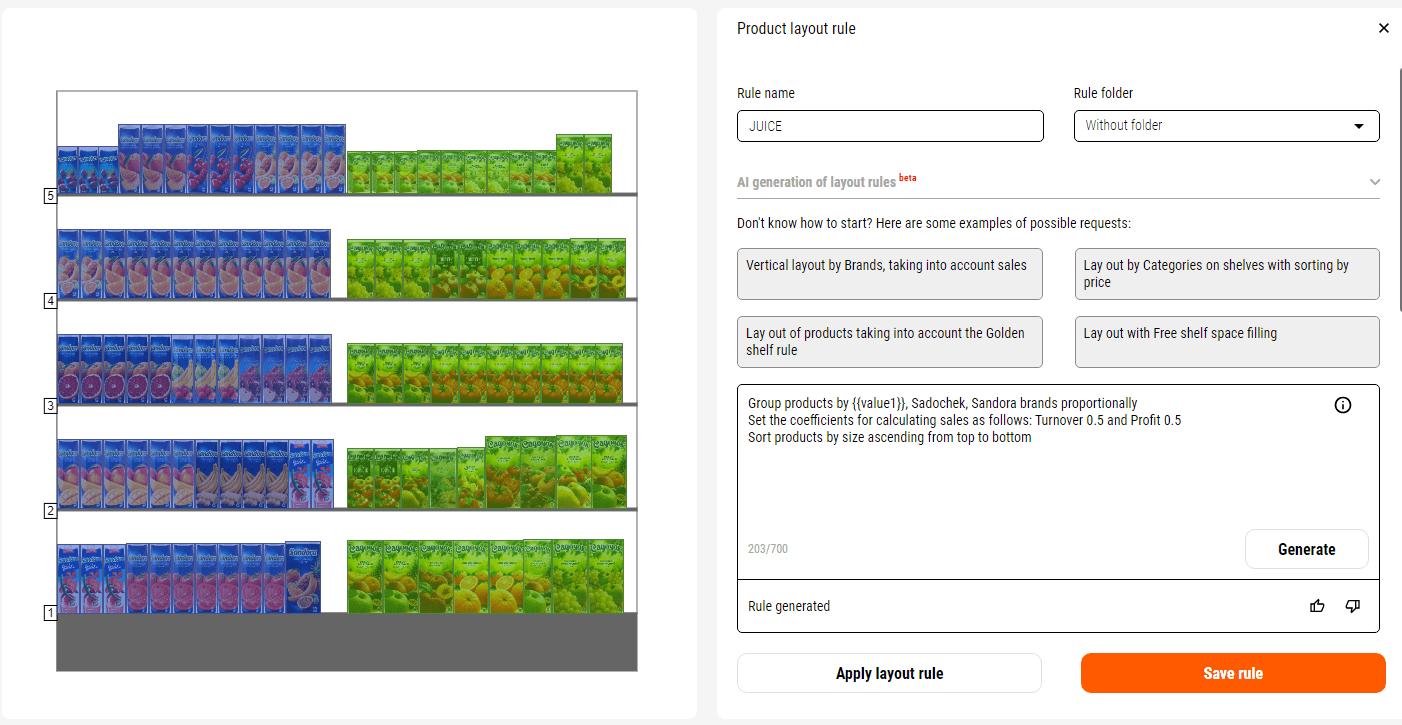
AI-powered layout rule in PlanoHero service
Creating a planogram layout with AI lets you factor in planned display or sales ratios when calculating product placement. You can describe the layout conditions in detail — group products by category, brand, or shelf, sort by price, or limit the number of facings or the height of the layout. And the layout rules created with AI can be applied immediately to other planograms across any store in the chain, which saves specialists time on manual layout adjustments and lets them focus on other priorities.
What's the Difference Between Planogram Creation, Execution, and Compliance Software?
Planogram creation is only the first stage of the process — it's worth knowing where it fits alongside the other two categories:
- Creation software (this page's focus) is about building the layout itself — product placement, fixture rules, AI-generated shelf logic.
- In-store execution software covers getting that layout actually installed on the sales floor — displays, pricing, staff coordination.
- Planogram compliance tools measure whether the shelf still matches the plan after it's been executed.
PlanoHero covers all three in one platform, but they're worth understanding as separate stages — a planogram that's well designed but never checked against the shelf doesn't deliver the sales it was built to drive.
FAQ
What's the difference between a planogram maker and planogram creation software?
A planogram maker is typically a general diagramming tool — fine for drawing a single layout by hand. Planogram creation software is built specifically for retail: product libraries, layout rules, AI-assisted generation, and the ability to manage planograms across many stores instead of one at a time.
Do I need AI to create a planogram?
No — you can build planograms manually with layout rules and templates. AI simply speeds up the process by generating placement rules from a plain-language description instead of setting each parameter by hand, which matters most once you're managing many planograms rather than just one.
How long does it take to move from Excel to dedicated planogram software?
It depends on how many planograms and stores you're migrating, but the main work is usually loading your product and fixture data once — after that, building and updating planograms is faster than in Excel, not slower, since the software carries layout rules and product data over automatically.
Looking for a service to create planograms?
Try a free demo version of PlanoHero